Thursday, June 6, 2013

Trifoliate Broadleaf Weeds Flowering in Turf

Kevin W. Frank
Assoc. Professor & Extension Turf Specialist


The trifecta of common trifoliate broadleaf weeds Black medic (Medicago lupulina), white clover (Trifolium repens), and yellow woodsorrel (Oxalis stricta) are all currently flowering and infesting turf. 

Clover, black medic, and yellow wood sorrel infesting turf.
Black medic and white clover are commonly found growing on low fertility, low maintenance sites, such as roadsides, boulevards, neglected home lawns, and in some cases golf course rough.  Black medic and clover are very competitive in low fertility sites because they host rhizobacteria that fix atmospheric nitrogen into plant available nitrogen.  A long-term strategy to reduce their competitiveness in turf is to ensure adequate fertility levels.  At a minimum I would suggest 2 lbs. N/1000 ft.2 year split over two applications to ensure the turf is dense and competitive.  Depending on the turf use and inherent soil fertility more than 2 lbs. N/1000 ft.2 may be necessary on many sites to produce a turf that is competitive with weeds.  Fall broadleaf herbicide applications are the most effective for controlling these weeds however treatment at flowering should produce results.  The most effective herbicides for controlling black medic and white clover contain the active ingredients fluroxypyr, triclopyr, or quinclorac.

Black medic.
Yellow woodsorrel, sometimes simply referred to as Oxalis, behaves as a summer annual in our climate and often infests voids left following elimination of broadleaf weeds following spring herbicide applications.  In contrast to black medic and white clover, yellow woodsorrel is not a nitrogen fixer and is found in a range of conditions including fertile soils, shady, sunny, and dry, so just about everywhere.  Effective herbicides for postemergence control of yellow woodsorrel include the active ingredients triclopyr and fluroxypyr.

Yellow woodsorrel with distinct heart shaped leaves.
Always read, understand, and follow the label directions. Mention or exclusion of specific products does not represent an endorsement or condemnation of any product by Michigan State University.

Thursday, May 30, 2013

This Weeks Turf Happenings: Seedheads, Hawkweed, & Mosquito Spray

Kevin W. Frank
Assoc. Professor & Extension Turf Specialist


Seedheads Surging in Turf

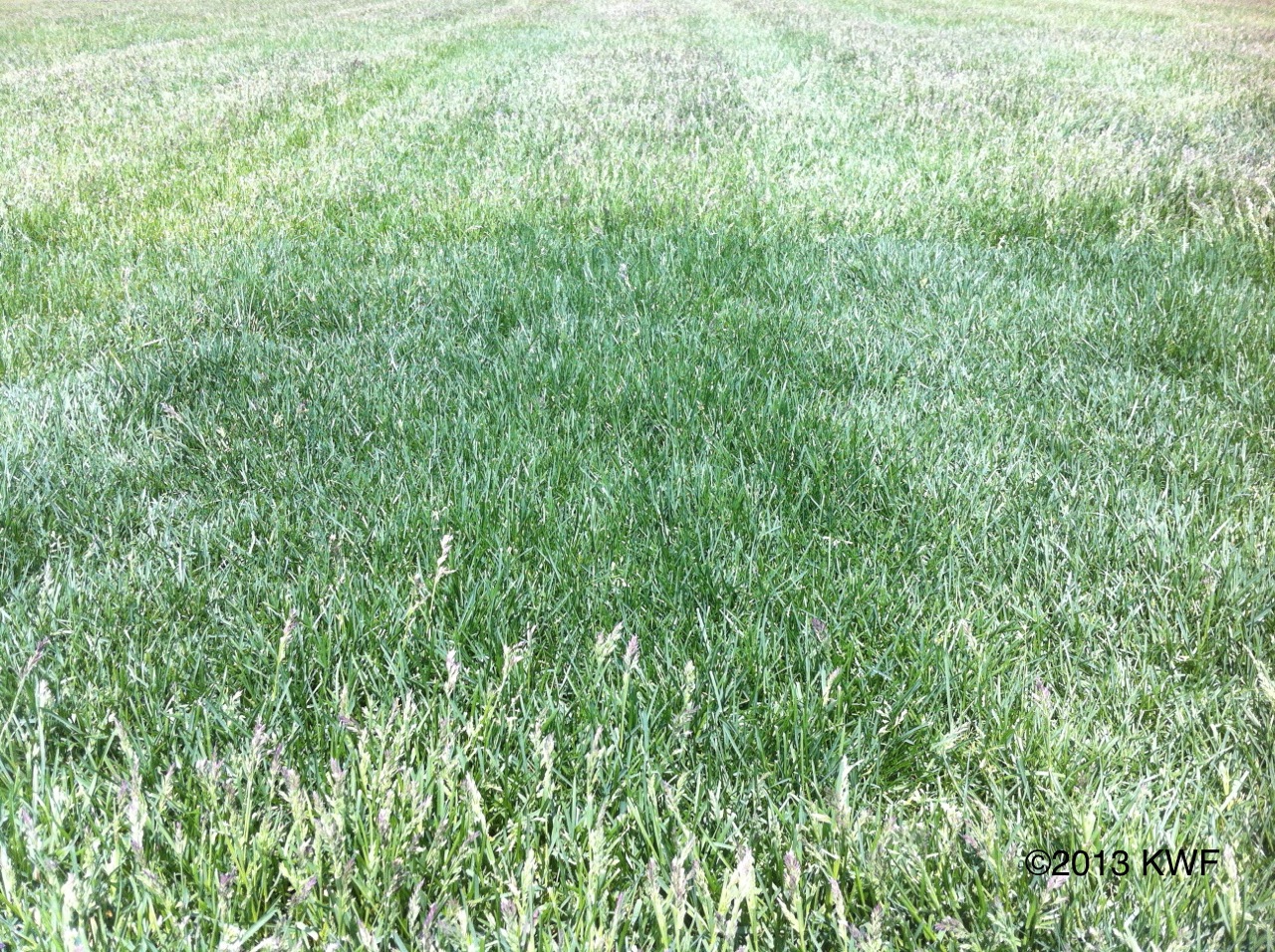
The cool season turfgrasses growing in Michigan have been in full-blown seed head production mode in the last week.  The common lawn grasses, Kentucky bluegrass, perennial ryegrass, and tall fescue all produce seedheads as do some grassy weeds like annual bluegrass (Poa annua).  Seedhead production requires energy from the plant so it is likely the turf will not only look stemmy due to the seed stalks but the turfgrass may even thin out.  Consider a fertilizer application following the seedhead flush to help the turf recover, especially if you haven’t fertilized yet this spring or fertilized back in April. Keep the mower blade sharp and don't lower the mowing height to try and remove seedheads.  Annual bluegrass produces seedheads below the 1/8 inch mowing height on golf course putting greens so lowering the mowing height is not going to solve the seedhead problem.  For those that think the lawn is going to be reseeded by the natural seedhead production, think again.  Even if the seed was allowed to reach maturity which would take about 4 months, allowed to dry, and then harvested, you’d still need to make sure that seed would find a home in the soil in order to germinate.  If you need to fill in some areas in your lawn it’ll be easier and more effective to go buy some seed. 


Seedheads in a Kentucky bluegrass lawn.


Kentucky bluegrass cultivars differ in seedhead production.

Yellow and Orange Hawkweed Flowering in Turf

One of the most consistent weed flowering events every year is yellow and orange hawkweed on Memorial Day weekend.  Somehow despite all the differences in spring weather we experience from year to year, hawkweed always seems to bloom on Memorial Day weekend.  Yellow hawkweed may look like dandelion to the untrained turfgrass eye but there are some differences.  Probably the most obvious difference between dandelion and yellow hawkweed is in the flower.  Although there are still some dandelions flowering out there, generally dandelion flowers earlier and also it only produces one flower per stalk.  In contrast, yellow hawkweed produces several flowers per stalk and appears in patches instead of as a single plant due to it’s creeping nature with stolons and rhizomes. This may facilitate the mowing around hawkweed patches that I often see, it’d be tough to mow around each individual dandelion plant.  Yellow and orange hawkweed are a little easier to tell the difference, hint..think color.  Hawkweed’s presence is often an indication of poor growing conditions and is often found near roadsides, in boulevards, or in country lawns that are rarely fertilized.  Although common broadleaf herbicides will be effective in control if you don’t improve the growing conditions it’s likely to be back. 

Yellow hawkweed with multiple flowers per stem.


Mosquito Spray Reminder on Turf

The start of this summer appears to be another fantastic year for mosquitos in Michigan. When you’re applying your favorite mosquito repellant to your legs, don’t apply it while standing on the turf.   Every year I see examples of mosquito spray killing turf on golf courses, usually next to the first tee but sometimes in the middle of the fairway.  Mosquito repellant usually isn’t going to kill the entire plant but will definitely kill the leaf tissue and leave some interesting crime scene like outlines of the perpetrator. 
Good reminder for golfers on mosquito spray damage.

Wednesday, May 22, 2013

Particle-Size Distribution of Topdressing Sand


Dr. Jim Crum and Dr. Trey Rogers

Nearly twenty years ago we initiated research to determine the engineering and agronomic properties of high-sand content root zones used in golf putting greens, athletic fields, and as topdressings to these surfaces.  We found to increase the strength and stability of surfaces it was necessary for the sand to have a wide distribution of sand particle sizes; including relatively significant proportions (up to 25%) of Very Coarse and Coarse sand (0.5 – 2.0 mm).  Sands of uniform size exhibit poor strength and stability because there are few particles of smaller size to fill the voids surrounding the sand particles and increasing surface friction and strength.

A recent article in the Green Section Record by Dr. James Murphy of Rutgers University suggests when a sand containing Very Coarse and Coarse sand sizes is topdressed to particularly dense turf, these larger particles remain on the surface, interfere with mowing and play, and need to be removed (http://tinyurl.com/pa5cxdv) (Murphy, 2007).  This implies the larger particles are not being incorporated into the plant canopy and are a deterrent.  A number of years ago an internship student completed an Independent Study at the golf course he was working where he collected the sand removed by the mowers following topdressing.  He and the superintendent wanted to know if the larger particles were being preferentially removed with mowing and leaving mainly the finer particle behind.  If that was the case, why not just apply the finer sand and not deal with the problems associated with larger particles.   The student’s unpublished data clearly suggested the particle-size distribution of the sand collected in the mower buckets was similar to the sand that was applied.  They concluded to continue to apply the wide-distribution sand even though more maintenance to bed-knifes and reels of mowers would be required.

Recently, Mavis Consulting, Ltd released an article where they measured the amount and sizes of sands removed with mowing following topdressing.  Go to  http://www.mavisconsulting.com/articles and look at the 2013 Sand Top-dressing  article, if interested.  Their findings were similar to those found by the internship student; the sand removed with mowing is similar to that which was applied.
The article from Rutgers suggests alleviating the problem of topdressing with sand containing the larger particles, topdress with a finer sand during the season and then following core cultivation use coarser sand to topdress and fill the cultivation holes.  Filling the core cultivation holes with the coarser sand would continue the connection of larger pores from the surface into the root zone and bypass layering issues.  During the length of their study they have not seen or measured negative effects of using the two materials.  Why might using these kinds of materials raise concerns?  There are many reasons to topdress turf surfaces, but diluting the accumulation of organic matter that creates a layer with smaller pores is probably the most important.  Discontinuities in materials that create different pore sizes have caused problems for years.   A layer of smaller pores lying above a layer of larger pores creates water-flow problems creating a near-surface layer holding more water and less oxygen. 

Even though Dr. Murphy has not seen any short-term negative effects of using two sands, it is our opinion not enough work has been done to determine the long-term effects of this practice.  We suggest, and believe, for the long-term health of these turf surfaces it is important to continue to use the same wide-distribution sands to topdress.  Yes, it will create more mower maintenance.  But for now we believe it is the best practice to follow.


Friday, May 17, 2013

Freeze Injury on Turf

Kevin W. Frank
Assoc. Professor & Extension Turf Specialist


Across many areas of Michigan night time low temperatures dipped into the mid to high 20’s on Monday morning, May 13.  While this event didn’t appear to be a serious killing event for many ornamentals I have observed some interesting freeze injury on turfgrasses.  My experience with this type of freezing event is that the symptoms mimic foliar burn from a fertilizer or pesticide application.  The visual symptoms to look for are on the leaf blade.  If you look closely you’ll notice the old leaf blades were burned/discolored from the leaf tip down about an inch.  Typically this damage is observed on higher cut turf, i.e. lawn height, and will disappear with new emerging growth and the next mowing.

Freeze injury mimics fertilizer burn or dull mower blade.
Freeze injury results in leaf tips 'burning back' a couple inches.


In addition to the typical burning look on the leaf tips I’ve also observed some very interesting freeze injury symptoms on different species.  Tall fescue clumps, contaminating a Kentucky bluegrass turf displayed freeze damage much greater than the bluegrass to the point it looks like someone sprayed them with RoundUp. 


Tall fescue clumps suffered freeze injury.

The lush, rapidly growing turf from a type II fairy ring suffered freeze injury that mimics what usually happens later in the summer from drought stress. 


Rapidly growing turf in fairy ring was damaged.

One type of freeze injury that brought a smile to my face was viewing the tip of quackgrass leaf blades burned down at least a couple inches from the freezing temperatures.  Unfortunately I doubt this will slow down the quackgrass for very long. 

Quackgrass leaf blades suffered only minor injury.

My theory for the damage to the fescue clumps, fairy ring, and quackgrass are that any rapidly growing, young leaves, were more susceptible to freeze injury than the slower growing or mature leaves.  Observing these symptoms also made me think about winterkill and the importance of turf not going into winter in an actively growing state where a rapid temperature drop would not just burn back some leaf blades but potentially kill the plant.